
- Blackjack is a comparing card game where you try to finish closer to 21 than the dealer without busting. Cards 2 to 10 count at face value, J/Q/K count 10, and an Ace counts 1 or 11.
- A "natural" blackjack is an Ace plus any 10-value card on the first two cards. The classic payout is 3:2, though some online and live tables pay 6:5, which materially reduces your return.
- Under near-perfect basic strategy and player-friendly rules, the house edge on standard blackjack sits at roughly 0.5%. Advertised returns such as RTP 99.70% are only achievable when basic strategy is followed on every hand, without exception.
- Online casino games, including real-money blackjack, are prohibited from being supplied to Australians under the Interactive Gambling Act 2001. ACMA blocks offshore sites continuously, and blackjack is one of the most commonly offered games on those blocked domains.
- Demo (free) blackjack is genuinely useful for learning rules and drilling decisions. Australian research, however, links simulated gambling, particularly social casino games, with later monetary gambling and gambling problems, especially among young people.
- Bonuses are rarely blackjack-friendly. Table games typically contribute only 5% to 10% toward wagering requirements, and more than half of online gamblers say bonus offers pushed their stakes higher.
- Payout claims of "10 minutes" apply to verified crypto withdrawals only. Card and bank withdrawals realistically take one to three business days, sometimes longer if KYC paperwork is incomplete.
Online Blackjack in Australia: Rules, Demo Play, Live Dealer Tables and Real-Money Strategy
Provider
Visionary iGaming
RTP
99.70%

- Author:Liam Hartley, iGaming analyst with eight years reviewing casino platforms, payments and game maths.
- Reviewed by:Erin Chalmers, responsible gambling and compliance editor.
- Last updated:June 2026. Next scheduled review: December 2026. 18+ only. Gambling involves risk. You can lose money. Never wager funds you cannot afford to lose.
Key takeaways before you play
How we tested and how this guide was built
This is not a rewritten press release. The commercial and technical observations below come from a structured, repeatable protocol:
- Real money in, real money out. We funded accounts with our own money, between A$100 and A$500 per site, across more than 20 platforms accessible to Australian users, then requested withdrawals rather than churning the balance to zero.
- Two payment rails per site. Where available, we tested one instant rail (PayID or crypto) and one traditional rail (card or bank transfer), recording the timestamp of the request and the timestamp of funds landing.
- Game-level rule audits. For every recommended table we opened the in-game rules panel and logged deck count, whether the dealer hits or stands on soft 17, double-after-split (DAS) permissions, surrender availability and blackjack payout ratio (3:2 versus 6:5).
- Bonus terms read line by line. Headline numbers were ignored. We recorded wagering multiples, blackjack contribution percentages, maximum bet while a bonus is active, expiry windows and withdrawal caps.
- Support stress tests at 3:00 am AEST. Live chat and email were tested well outside business hours with a specific, non-scripted question about withdrawal verification. Response time and whether the answer matched the published terms were both scored.
- Licence verification. We cross-checked licence numbers, the registered company name in the terms and conditions, and the regulator's public register. Mismatched company names, copied licence seals or dead licence links were treated as automatic disqualifiers.
- Mobile testing on iOS and Android over both 4G and Wi-Fi, checking stream stability, control placement on small screens and lobby-to-cashier navigation.
"Even when the paperwork checks out, an operator still has to pass a real-money withdrawal test before it belongs on a recommendation list." Liam Hartley, iGaming analyst (author's testing protocol, 2026)
Where evidence is unavailable or contested, this guide says so explicitly rather than filling the gap with confident-sounding numbers. That happens more often than most rankings admit.
Scope, concepts and evidence base
This article covers four things: how blackjack actually works, how demo play differs from real-money play, how live dealer blackjack is produced and regulated, and what independent Australian research says about online casino gambling and its harms. Product commentary comes from hands-on testing. Population-level statements come from published Australian research and regulator statements, each cited inline.
Two structural facts frame everything that follows. First, blackjack keeps a mathematical advantage for the house under all standard rule sets, because the game is designed so that long-run expected value for the player is negative. Second, real-money online casino gambling is not a licensed, locally regulated product for Australians. That means player protections which exist in Australian sports betting, such as national self-exclusion, do not reliably apply to offshore casino sites.
If you want to understand which online casino formats exist and how operators describe their conditions and responsible gambling tools, the iGaming platform catalogue on gucci9-official.com collects reviewed platforms and their published terms in one place.
Blackjack as an online casino product: formats and definitions
What blackjack is and how the game is played
Blackjack is a comparing card game played between one or more players and a dealer. Standard published rule sets describe the objective the same way: each player forms a hand whose total is closer to 21 than the dealer's total, without exceeding 21. Exceeding 21 is a "bust" and loses immediately, no matter what the dealer subsequently does. That single rule is precisely where the house advantage originates, because the player acts first.
The dealer does not make strategic choices. The dealer follows a fixed, published procedure, typically "draw until reaching a hard 17 or higher", while the player makes the decisions. That asymmetry is why blackjack rewards disciplined decision-making more than most casino games.
It is also why no decision pattern eliminates the house edge under normal casino conditions.
The game is traditionally dealt from one, two, four, six or eight decks. Deck count is not cosmetic. It changes the probability of drawing a 10-value card, and therefore changes both the correct play in borderline situations and the theoretical return.
Cheat sheet: what the cards are worth
| Card | Value in blackjack |
|---|---|
| 2, 3, 4, 5, 6, 7, 8, 9, 10 | Face value (a 3 counts as 3 points) |
| Jack | 10 |
| Queen | 10 |
| King | 10 |
| Ace | 1 or 11, whichever gives the better total without busting |
| Ace plus any 10-value card (first two cards) | Blackjack, the "natural" 21 |
In text form: number cards are worth their printed value, all three picture cards (Jack, Queen, King) are worth 10, and the Ace flexes between 1 and 11 depending on your hand. An Ace with a 10, Jack, Queen or King on the opening two cards is a natural blackjack.
Suits are irrelevant to the main hand total. They matter only for certain side bets, such as Perfect Pairs.
Hard hands, soft hands and why the distinction matters
A soft hand contains an Ace counted as 11. A hard hand contains no Ace, or contains an Ace that must be counted as 1 to avoid busting.
| Hand | Total | Type | Why |
|---|---|---|---|
| 10 + 6 | 16 | Hard 16 | No Ace available to flex |
| A + 6 | 17 | Soft 17 | Ace counted as 11, so you cannot bust by drawing |
| A + 9 + 3 | 13 | Hard 13 | Ace must count as 1, otherwise the hand busts |
| A + A + 8 | 20 | Soft 20 | One Ace counts 11, the other counts 1 |
| 9 + 8 | 17 | Hard 17 | Any draw risks busting |
The practical consequence is simple. A soft 17 can be improved risk-free, while a hard 17 usually cannot. Strategy charts treat them as entirely different hands, and so do dealer rules.
Blackjack and other casino-style interactive gambling services
In Australian regulatory language, an online blackjack table supplied for money is a casino-style interactive gambling service, the same legal category as online roulette, baccarat, online pokies and virtual poker against the house. This classification matters more than the game's name, because it decides whether the product may lawfully be supplied to people in Australia at all.
Popular blackjack variants compared
| Variant | Key rules and differences | Practical note |
|---|---|---|
| Classic blackjack / Vegas-style | Dealer takes a hole card; dealer stands on all 17s or hits soft 17 depending on the table; DAS often allowed | The benchmark for basic strategy charts |
| European Blackjack | Dealer takes the second card after the player acts (no hole card); usually two decks; no early surrender | Changes correct play against Ace and 10 upcards |
| Atlantic City Blackjack | Eight decks, dealer stands on soft 17, late surrender permitted, DAS allowed | Often the most player-friendly rule combination available online |
| Blackjack Switch | Two hands dealt; player may swap the second cards between hands; blackjack usually pays 1:1 and dealer 22 pushes | Rule trade-offs offset the switching advantage |
| Perfect Blackjack / Perfect Pairs tables | Standard game plus a pair-based side bet | The side bet carries a far higher house edge than the main game |
| Blackjack Surrender | Player may forfeit the hand after seeing the dealer's upcard and recover half the stake | Only correct in a narrow set of hands |
| Single Deck / Multihand | One deck, or several simultaneous player hands | Single deck often pays 6:5 on blackjack, which cancels the deck-count benefit |
Always confirm the rules in the game's own information panel. Two blackjack games with identical names from different studios can differ on soft 17, surrender and payout ratio. We have seen exactly that inside a single lobby.
Blackjack rules: how a round plays out, step by step
Bets, the initial deal and the hole card
- Betting. All wagers, including side bets, are placed before any cards are dealt. Once dealing begins, the main bet cannot be withdrawn.
- Initial deal. Each player receives two cards. The dealer receives two: one face up (the upcard) and, in most rule sets, one face down (the hole card).
- Blackjack check. If the dealer's upcard is an Ace or a 10-value card, many tables check for a natural before play continues. European-rules tables skip this step, because the dealer's second card has not been dealt yet.
- Player decisions. Each player acts in turn: hit, stand, double, split or surrender, where the rules allow.
- Dealer play. The dealer reveals the hole card and draws according to the fixed table rule.
- Comparison and settlement. Winning hands are paid, losing hands lose the stake, and equal totals push, meaning the stake is returned.
The soft 17 rule, the detail most guides skip
Two dealer rules dominate online blackjack:
- Stand on all 17s (S17): the dealer stops on any total of 17, including soft 17.
- Hit soft 17 (H17): the dealer must draw on soft 17, but stands on hard 17.
H17 increases the house edge by roughly 0.2 percentage points. That is a large amount in a game whose total edge can be around 0.5%. Some well-known live products use the H17 rule. Visionary iGaming's live blackjack, for example, has the dealer stand on a hard 17 but hit on a soft 17, dealt from six manually shuffled decks with double-after-split permitted except on split Aces. If two otherwise identical tables are open, the S17 table is the better table. Every time.
Core player decisions
- Hit:take another card. Available repeatedly until you stand or bust.
- Stand:end your turn and keep your current total.
- Double down:double the original wager and receive exactly one additional card, then stand automatically. Most tables restrict doubling to the first two cards, and some restrict it further to totals of 9, 10 or 11.
Split, insurance and surrender: the extra options and their actual maths
- Split. Available on two cards of equal rank. Each becomes a separate hand with a separate wager. Expected value depends on deck count, whether re-splitting is allowed, whether Aces may be split and re-split, and whether DAS is permitted. There is no universal "always split" rule beyond Aces and 8s under standard conditions.
- Insurance. A side wager, up to half your main bet, offered when the dealer shows an Ace, paying 2:1 if the dealer holds blackjack. Insurance is only mathematically profitable when the probability of a 10-value hole card exceeds one in three (33.3%). In ordinary multi-deck shoes it does not, which is why basic strategy declines insurance, including "even money" on your own blackjack.
- Surrender. Forfeit the hand and recover half the stake. Correct only when your expected loss on the hand exceeds 50% of the wager, classically hard 16 against a dealer 9, 10 or Ace under late-surrender rules. Early surrender, offered before the dealer checks for blackjack, is rare online and more valuable when you find it.
Round flow in one line
Place bet → cards dealt → blackjack check → player acts (hit, stand, double, split or surrender) → dealer completes the hand → totals compared → payouts settled → next round.
Blackjack demo and real money play: what actually changes
Where blackjack demo mode genuinely helps
Free blackjack runs the same game logic with play-money credits. Its legitimate uses are narrow but real:
- Learning card values, dealer rules and the betting sequence without financial exposure.
- Drilling basic strategy decisions until they become automatic rather than considered.
- Comparing rule sets between variants. Checking whether a table pays 3:2 or 6:5, and whether surrender is offered, costs nothing in demo mode.
- Testing interface behaviour on a phone: whether hit, stand and double controls stay reachable at the bottom of the screen instead of being shrunk down from a desktop layout.
What demo mode cannot replicate
Demo play removes the one variable that drives most poor decisions: consequence. It excludes real balance changes, withdrawal conditions, verification friction, and the pressure of a losing streak when the money on the table is rent money. A profitable demo session tells you nothing about bankroll performance, and demo win frequency is not a reliable predictor of real-money outcomes.
Real money blackjack versus free blackjack
| Real-money blackjack | Free / demo blackjack |
|---|---|
| Cash winnings are payable, subject to verification and withdrawal terms | No withdrawal possible; credits have no cash value |
| Access to bonuses, cashback and tournaments, with restrictive terms for table games | No wagering requirements and no terms to breach |
| Far wider variant and live dealer availability | Limited to RNG titles; live tables are almost never free |
| Full financial risk, including loss chasing | No monetary loss |
| Live dealer social interaction and higher table limits | Ideal for strategy drilling and rule comparison |
| Requires registration, KYC and a funded account | Instant play, usually no sign-up |
What to settle before you play blackjack for real money
- Bankroll separation. Use a dedicated amount that is not committed to bills, rent or credit repayments.
- Bet sizing. Keep individual wagers small relative to your session bankroll. A widely used discipline rule is never staking more than about 5% of your stack on one hand, and certainly never more than half, which is reckless by any standard.
- Table minimums and maximums. Match the table to your bankroll, not the other way around. A A$5 minimum table with a A$10,000 ceiling is not a A$50 bankroll table.
- Currency and conversion. AUD-denominated accounts avoid conversion spreads. Crypto balances stack exchange-rate volatility on top of gambling risk.
- Loss and time limits set in advance, written down, before the first hand.
Responsible gambling note: real money blackjack carries genuine financial risk and no strategy removes it. Set deposit, loss and session limits before you play, avoid borrowed funds or credit, and check the age and regional access conditions that apply to you. If play stops feeling like entertainment, use the platform's limit and self-exclusion tools, or call Gambling Help Online on 1800 858 858.
Live blackjack and blackjack live dealer tables: how the format works
How a live blackjack studio actually works
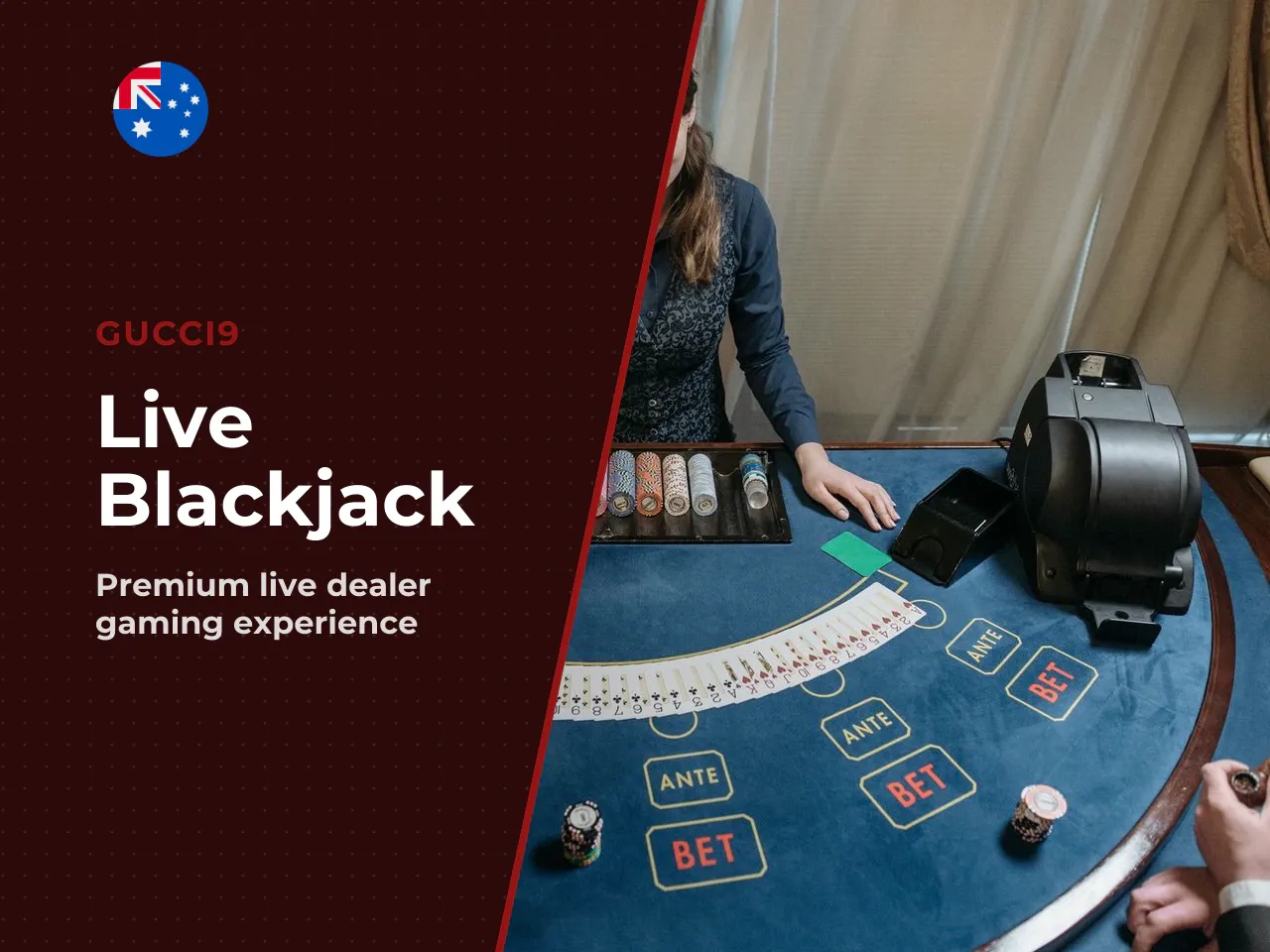
Live blackjack is filmed, not simulated. A physical table, a real dealer and real cards are captured by multiple cameras and streamed to your device in real time.
- Cameras cover the table, shoe and dealer continuously, with close-ups triggered as cards are dealt.
- Optical character recognition (OCR) reads card values from the video feed and converts them into game data, so the on-screen hand state updates without manual entry.
- The dealer is a real person following the studio's fixed procedure, including shuffle and reshuffle rules. Some studios shuffle six decks manually, which many players prefer for transparency.
- The virtual betting interface transmits your stake to the game server, matches it to the current round and settles the result through the game engine. Round timing is dictated by the live stream, not by you.
The core difference from RNG blackjack is the source of randomness: a physical shoe dealt on camera, versus a certified random number generator producing outcomes in software.
Live blackjack tables you will encounter
- Standard live blackjack:seven seats, ordinary rule set, live shoe.
- Speed Blackjack:shortened decision windows and rapid dealing, which increases hands per hour and therefore increases expected loss per hour at the same stake.
- Infinite or unlimited-seat blackjack:hundreds of players play the same dealer hand at once, so seats are almost always available during peak periods.
- Free Bet Blackjack:certain doubles and splits are granted at no additional cost, offset by a dealer 22 push rule.
- VIP, Super Stake and high-limit tables:table maximums on some platforms reach around A$10,000 per hand.
- Bet Behind:wager on another seated player's hand when the table is full.
Popular side bets in live casino blackjack
- Perfect Pairs pays when your first two cards form a pair, with higher payouts for suited pairs.
- 21+3 pays when your two cards plus the dealer's upcard form a poker combination such as a flush or straight.
Both carry substantially higher house edges than the main wager. They are entertainment bets, not value bets, and the paytable is where the cost hides.
Demo, RNG and live dealer compared
| Criterion | Demo (free) | RNG real money | Live dealer |
|---|---|---|---|
| Speed of play | Player-controlled, fastest | Player-controlled, fast | Dealer- and stream-controlled |
| Bet limits | None (play credits) | Usually low minimums, moderate ceilings | Low minimums to high-roller ceilings, up to roughly A$10,000 on some tables |
| Seats | Single player | Single player, multihand options | Seven seats, or unlimited on Infinite-style tables |
| Human dealer | No | No | Yes |
| Social element | None | None | Chat with the dealer and other players |
| Bonus eligibility | Not applicable | Often limited (5% to 10% contribution) | Frequently excluded, or the lowest contribution of all |
| Outcome source | Software RNG | Certified RNG | Physical cards on camera |
Dealer rules by provider: what to verify before you sit down
| Provider / table | Decks | Soft 17 | Double after split | Surrender | Verification status |
|---|---|---|---|---|---|
| Visionary iGaming Live Blackjack | 6, manually shuffled | Dealer hits soft 17, stands hard 17 | Allowed, except on split Aces | Not offered | Confirmed in published rules |
| Pragmatic Play live blackjack lobby | Typically 8 | Varies by table; check the panel | Commonly allowed | Table-dependent | Verify the in-game rules panel per table |
| Lucky Streak live tables | Typically 8 | Varies by table | Commonly allowed | Table-dependent | Verify the in-game rules panel per table |
| Evoplay Blackjack Lucky Sevens (RNG) | Multi-deck | Per game rules | Per game rules | Per game rules | Advertised RTP 99.70% under basic strategy only |
| BGaming / Nucleus RNG range (European, Single Deck, Multihand, Surrender) | 1 to 8 depending on title | Per title | Per title | Available on Surrender titles | Verify per title; single-deck titles often pay 6:5 |
Treat "verify in-game" as an instruction, not a formality. Studios change rule sets without notice, and the rules panel is the only authoritative source at the moment you play.
Gambling live streams and influencer content
Live dealer and casino content has migrated to streaming platforms, where it works as promotion as much as entertainment.
"Gambling streams frequently include links to external casino sites and reinforce thinking associated with gambling harm." Marcus Johnson, University of Sydney Game and Play Lab (2025). https://www.sydney.edu.au/news-opinion/news/2025/04/gambling-live-streams.html
Australian research indicates a strong association between exposure to gambling live streaming and later gambling behaviour, so stream-watching is not a neutral spectator activity. If you use streams to learn blackjack strategy, separate the instructional content from the promotional links bolted onto it.
Prevalence and patterns of online casino gambling in Australia
National participation and interactive gambling growth
Australia has one of the highest per-capita gambling participation rates in the world. Population surveys have found that roughly two-thirds of Australian adults spent money on some form of gambling in a 12-month period, and around one in four adults aged 18 or over used a gambling product or service in the past year.
"The prevalence of interactive gambling doubled from 8.1% in 2010–11 to 17.5% in 2019." Second National Study of Interactive Gambling in Australia, Hing et al., 2019–20 (updated 2024). https://www.gamblingresearch.org.au/publications/second-national-study-interactive-gambling-australia
Online casino and blackjack-related participation
Online casino gambling remains a small slice of that activity. In New South Wales, past-year online casino participation rose only slightly, from 0.5% in 2019 to 0.8% in 2024, while online gambling overall grew dramatically.
Device usage and mobile access to blackjack-type games
Interactive gambling in Australia is overwhelmingly mobile.
"Online gamblers spend slightly more than half of their betting expenditure via smartphones." Second National Study of Interactive Gambling in Australia, Hing et al., 2019–20. https://www.gamblingresearch.org.au/publications/second-national-study-interactive-gambling-australia
That has direct product consequences for mobile blackjack games. Control placement, stream stability on 4G, and the distance between the lobby and the cashier all shape how long and how fast people play. Platforms that keep hit, stand and double buttons fixed at the bottom of the screen, rather than shrinking a desktop layout, reduce misclicks. They also make continuous play easier. Both effects are real, and neither cancels the other.
Want to see which casino formats and conditions exist before you register? The platform comparisons on gucci9-official.com set out published terms, payment rails and responsible gambling tools side by side.
Legal and regulatory environment for online blackjack
Disclaimer: this information is general in nature and does not constitute legal advice. Gambling legislation can change; confirm the current position with the relevant regulator or a qualified legal adviser before acting.
Prohibition of online casino games under the Interactive Gambling Act
The Interactive Gambling Act 2001 (Cth) prohibits the supply of interactive casino-style gambling services, including real-money blackjack, roulette, baccarat, online pokies and house-banked poker, to people physically present in Australia. The prohibition targets suppliers, not individual players. Australians who gamble at offshore casinos are not the subject of the offence provisions, but they also receive none of the protections that licensed domestic products carry.
The Australian Communications and Media Authority (ACMA) enforces the regime, investigating complaints and asking internet service providers to block non-compliant services. In a single quarter of 2024, ACMA blocked 50 websites.
"The majority of blocked sites were offering casino games, blackjack, roulette, poker and pokies, to Australian users." ACMA, Action on Interactive Gambling, April to June 2024. https://www.acma.gov.au/action-interactive-gambling
What is and is not permitted
- Permitted with a licence: online sports and race wagering placed pre-event, lotteries and keno through licensed operators.
- Prohibited: online casino games for money, in-play sports betting online, and credit betting.
- State and territory regulators licence wagering operators and land-based venues, while the Commonwealth regime governs the interactive prohibition.
The practical consequence for blackjack players is worth stating plainly. An offshore casino's Curaçao or Anjouan licence provides a basic layer of oversight, but it does not give you access to Australian dispute resolution, and it does not connect to Australian self-exclusion infrastructure.
Regulatory gaps for simulated gambling and social casino blackjack
The prohibition covers real-money supply. It does not cover simulated gambling. Social casino apps that replicate blackjack, pokies or poker can be downloaded and played by minors, frequently with in-app purchases of virtual credits, a structure that sits outside gambling regulation because no cash prize is payable. Loot boxes and gambling-like mechanics in video games occupy the same gap. Regulatory reviews have repeatedly named this as an unresolved consumer protection issue, and the specific classification treatment continues to evolve, so check current government guidance rather than assuming.
Simulated blackjack, demo play and convergence with monetary gambling
Adolescent and adult engagement with simulated casino games
Simulated gambling, meaning demo casino games, social casino apps and gambling-themed video game content, reaches a large share of Australian young people. Exposure to gambling-like activities during adolescence is high by any measure.
"Among 1,287 school students aged 12–17 in South Australia, 31.5% reported past-year participation in simulated gambling." Hing et al., The convergence of simulated gambling, monetary gambling and problem gambling (2025). https://www.health.gov.au/resources/publications/convergence-simulated-gambling-monetary-gambling-problem-gambling
Simulated gambling, gaming disorder and blackjack-like content
Not all simulated formats carry equal risk. Research examining different product types found the strongest links for social casino games, the category that most closely replicates blackjack and pokies mechanics.
"Adolescents who played social casino games in the past month were 2.5 times more likely to meet criteria for gaming disorder than non-participants." Hing et al., "Not all games are created equal", Journal of Behavioral Addictions (2023). https://akjournals.com/view/journals/2006/aop/article-10.1556-2006.2023.00040/article-10.1556-2006.2023.00040.xml
Order of first play and association with gambling harm
Sequencing evidence suggests simulated formats commonly come first, working as early exposure points rather than harmless side activities.
"Loot boxes and gambling-like video games generally precede monetary gambling among young people aged 18–25." Russell et al., "Order of first play in simulated versus monetary gambling", Journal of Behavioral Addictions (2023). https://akjournals.com/view/journals/2006/12/3/article-p688.xml
None of this makes demo blackjack useless for an informed adult learning basic strategy. It does mean demo play should be understood as a gateway product with documented behavioural effects, particularly where minors can reach it, and particularly where demo return rates run more generous than real-money conditions.
How to choose a blackjack casino: verification, terms and payments
The seven-point verification checklist
Use this before depositing anywhere. Failing any single item is reason enough to walk away.
- The licence is real and current. The licence number, registered company name and regulator record must match the entity named in the terms and conditions. Dead links, copied seals and conflicting company names are immediate disqualifiers.
- KYC and AML processes are disclosed up front. Identity and source-of-funds checks should be explained before you deposit, not sprung on you at withdrawal.
- RNG and game fairness are independently certified. Look for testing by accredited laboratories such as eCOGRA or iTech Labs, working to ISO/IEC 17025-aligned procedures.
- Game rules and returns are published. Blackjack rules, deck counts, payout ratios (3:2 versus 6:5), table limits and side bet paytables should be visible in-game.
- Responsible gambling tools actually work. Deposit, loss and session limits, reality checks and self-exclusion must be available in the account area, not merely described on a policy page.
- Payment terms are transparent. Accepted methods, fees, minimums, withdrawal caps and processing windows should be stated before registration.
- A complaints and dispute pathway exists, naming an alternative dispute resolution body. If none is named, you have no escalation route at all.
Applying these criteria consistently is the core of evaluating online casinos in a market where marketing claims routinely outrun verifiable fact.
Bonuses and wagering: why blackjack is the awkward game
Bonus offers are engineered around pokies, not table games. The restrictions we recorded again and again in testing:
- Blackjack contribution of 5% to 10% toward wagering requirements, and in some terms, complete exclusion. A A$1,000 bonus with a 40x wagering requirement and 5% blackjack contribution demands an impractical volume of table-game turnover.
- Live blackjack often contributes least of all, sometimes zero.
- Maximum bet caps while a bonus is active, commonly A$5 per hand, which stops you using a table-appropriate stake.
- Time limits on clearing requirements, plus withdrawal caps on bonus-derived winnings.
- Live casino cashback offers, for example 25% up to A$300, are frequently better value for blackjack players than headline deposit matches, because they do not depend on contribution rates.
The behavioural risk is documented, not theoretical:
"More than half (51.1%) of online gamblers who saw bonus offers agreed their betting increased as a result." Second National Study of Interactive Gambling in Australia, Hing et al., 2019–20. https://www.gamblingresearch.org.au/publications/second-national-study-interactive-gambling-australia
Bonuses are not neutral incentives. They actively encourage higher stakes and longer sessions, which in a negative-expectation game means larger expected losses. Read the contribution rate before the headline number, always.
Payment methods: realistic timings, fees and limits
| Method | Typical withdrawal time | Typical fee | Minimum deposit | Notes |
|---|---|---|---|---|
| Crypto (BTC, ETH, LTC, USDT, TRX) | 10 minutes to a few hours after KYC is complete | 0% operator fee plus network fee | Roughly A$10 to A$20 | Fastest rail in our tests (BTC cleared in 20 minutes on one platform, just over an hour on another); adds exchange-rate risk |
| PayID or instant bank transfer | Same day to 24 hours | Usually 0% | Roughly A$10 to A$20 | Fast for deposits; withdrawal support varies by operator |
| E-wallets (PayPal, MiFinity, eZeeWallet) | 0 to 2 business days | 0% to 2% | Roughly A$10 to A$20 | Availability for casino transactions is inconsistent |
| Cards (Visa, Mastercard) | 1 to 3 business days | 0% to 2.5% | Roughly A$20 | Card deposits to offshore casinos are frequently declined by Australian issuers |
| Bank transfer | 2 to 5 business days | 0% or a flat fee | Roughly A$20 to A$50 | Slowest rail, but the highest limits |
| Prepaid vouchers (Neosurf) | Deposit only | Purchase fee applies | Roughly A$10 | No withdrawal route, so you will need a second method |
| Mobile wallets (Apple Pay, Google Pay) | Deposit only, typically | 0% | Roughly A$10 | Convenient deposits, no withdrawal capability |
Fact-check on payout claims. Marketing lines such as "average payout processing of only 10 minutes" are achievable, but only for cryptocurrency withdrawals from a fully verified account. Fiat withdrawals in our testing took from 24 hours to several business days. Any site advertising 10-minute payouts across all methods is overstating what it can do.
Casinos we suggest you avoid, and why
A recommendation list without a rejection list is a marketing page. We do not publish operator names in the rejection column, because licence ownership and management change frequently and stale accusations are unfair. Instead, here are the exact scored failure patterns that removed platforms from our shortlist, so you can spot them yourself.
Rejected platform profile A, score 1.2/5
- Hidden 60x wagering requirement disclosed only in a secondary terms document.
- Withdrawal delays beyond seven days on verified accounts.
- Account closures at withdrawal request with no reason given.
Rejected platform profile B, score 1.6/5
- Aggressive time limits for clearing wagering requirements, in one case 72 hours.
- Slow, template-only support responses to bonus queries.
- Advertised promotions not actually available inside the account.
Rejected platform profile C, score 1.3/5
- Very small eligible payment method list, with no withdrawal-capable option matching the deposit rail.
- Multiple reports of bonuses not credited after qualifying deposits.
- Licence seal linked to a company name different from the one in the terms.
Automatic disqualifiers, in every case: an unverifiable licence, changed withdrawal limits after deposit, unexpected verification demands introduced only at cash-out, and any table advertising an RTP that its own published rules cannot support.
Blackjack strategy, bet sizing and bankroll management
Basic strategy is a rule-specific tool, not a universal chart
Basic strategy is a table of mathematically optimal decisions for every combination of player hand and dealer upcard, derived from probabilities rather than intuition. Critically, the correct chart changes with the rules. Deck count, whether the dealer hits soft 17, whether surrender is offered, and whether doubling after split is permitted all alter individual cells.
Playing an eight-deck H17 chart at a two-deck S17 European table will cost you money. Confirm the rules first, then apply the matching chart. Sounds obvious, yet it is the most common avoidable leak we see.
Basic blackjack strategy for typical hands
A few anchors that hold under standard multi-deck rules:
- Hard 8 or lower:hit. There is nothing to protect.
- Hard 11:double where the rules allow it, otherwise hit.
- Hard 12 to 16 against a dealer 2 to 6:stand and let the dealer risk busting.
- Hard 12 to 16 against a dealer 7 to Ace:hit, or surrender hard 16 against 9, 10 or Ace if late surrender is offered.
- Hard 17 or higher:stand.
- Soft 13 to 18:hit or double depending on the dealer upcard; soft 18 against a dealer 9, 10 or Ace is a hit, not a stand.
- Always split Aces and 8s. Never split 10s or 5s.
- Decline insurance,including even money on your own blackjack.
Those lines are a summary, not a substitute for the full chart matched to your table.
The house edge and what RTP figures actually mean
Under standard rules and accurate basic strategy, the house edge on blackjack sits at roughly 0.5%, equating to about 99.5% return to player. Some titles advertise higher:
- Blackjack Lucky Sevens (Evoplay), advertised RTP 99.70%
- 21 Burn Blackjack, advertised RTP 99.50%
- Gold Saloon Blackjack, advertised RTP 99.5%
- Multihand Blackjack, advertised RTP 99.23%
These figures assume perfect basic strategy on every hand. Deviate, take insurance, chase losses, or play a 6:5 blackjack table, and your effective return drops well below the published number. Note as well that "win rate" percentages quoted for casinos rather than games, such as "win rate 96.25%", are marketing constructs rather than measurable returns. Compare RTP at the game level, or not at all.
Because the edge is structural, blackjack keeps a positive house edge even under optimal play. Across a large number of hands, the operator is mathematically expected to profit. Strategy reduces the rate of loss. It does not reverse the sign.
Betting systems and card counting: an honest assessment
Progression systems, Martingale and its many variants, redistribute volatility. They do not alter expected value, and they collide with table maximums and bankroll limits precisely when they most need to keep doubling.
Card counting can theoretically reduce or reverse the edge in physical games with deep penetration. Online it is severely constrained: continuous shuffling, frequent reshuffles, RNG games that reset the deck each hand, and operator countermeasures including bet-limit changes and account restrictions.
No published Australian evidence supports the idea that counting produces reliable long-run profit in online blackjack, and any content promising guaranteed winning systems should be read as promotional rather than analytical.
Flat betting, staking the same amount every hand, is the most defensible approach for recreational players. It does not improve RTP, but it makes losses predictable and it prevents escalation.
Bets, limits and responsible gambling in practice
Money management does more for a blackjack session than any decision chart. Decide the session budget first, then pick the stake, then pick the table. Reverse that order and the table picks you.
- Keep the per-hand stake fixed, and small, relative to the bankroll.
- Set deposit and loss limits inside the account, not in your head.
- Use reality checks or a phone timer so a 20-minute session does not quietly become two hours.
- Treat the balance as spending on entertainment, not as a working float you expect to grow.
Pre-session self-check
Run through this before the first hand. If you answer "no" to any item, do not play.
- I have confirmed this table's deck count, soft 17 rule and blackjack payout (3:2, not 6:5).
- I am using the basic strategy chart that matches these exact rules.
- I have tested the variant in demo mode, so the controls and options are familiar.
- My session bankroll is money I can afford to lose entirely.
- I have set a loss limit and a time limit, and I have written them down.
- My per-hand stake is a small fixed percentage of my bankroll, never more than 5%.
- I have read the bonus terms, including blackjack contribution and maximum bet, or I am playing without a bonus.
- My account is fully verified, so a withdrawal will not stall at KYC.
- I am not playing to recover previous losses.
- I am not playing while affected by alcohol, medication, exhaustion or emotional distress.
- I know how to set deposit limits and how to self-exclude on this platform.
Player protection, responsible gambling and practical implications
Use of consumer protection tools among interactive gamblers
Australian research consistently finds low uptake of the protective features operators provide: deposit limits, loss limits, time reminders, self-exclusion. Given the harm profile of online gambling, that low usage is genuinely concerning.
"Online gamblers are nearly three times more likely to be classified as problem gamblers: 3.9% compared with 1.4% among non-online gamblers." Second National Study of Interactive Gambling in Australia, Hing et al., 2019–20. https://www.gamblingresearch.org.au/publications/second-national-study-interactive-gambling-australia
Gambling harms and product attribution: blackjack versus pokies
Blackjack is not the primary driver of gambling harm in Australia. Electronic gaming machines are.
"There is incontrovertible evidence that more than half of gambling problems in Australia are caused by electronic gaming machines." Russell et al., Journal of Behavioral Addictions (2023), citing composite population research. https://akjournals.com/view/journals/2006/12/3/article-p688.xml
That does not make blackjack safe. It means product-specific risk should be judged on structural characteristics, meaning speed of play, continuity, stake escalation and bonus-driven session extension, rather than on the game's name. A Speed Blackjack table played at maximum stake with an active bonus has a very different risk profile from a A$1 flat-bet session at a standard table.
Practical implications for real money blackjack play
- Choose rules before you choose brands. S17, 3:2 blackjack, DAS and late surrender are worth more than any welcome offer.
- Treat bonuses as constraints, not gifts. If blackjack contributes 5%, that bonus is not for you.
- Set deposit and loss limits at registration, before the first deposit, while judgement is intact.
- Prefer a verified-account crypto or PayID rail if withdrawal speed matters, and finish KYC before you win, not after.
- Slow the game down. Fewer hands per hour means less expected loss at identical stakes. Speed formats invert this.
- Use national supports. Gambling Help Online is available 24/7 on 1800 858 858 and at gamblinghelponline.org.au. BetStop, the National Self-Exclusion Register, stops licensed Australian wagering operators contacting or accepting accounts from registered users. Bank-level gambling transaction blocks are available from most Australian banks.
Disclaimer: this information is general in nature and is not a substitute for advice from a responsible gambling professional or a licensed financial adviser. If gambling is causing financial, relationship or emotional harm, contact Gambling Help Online on 1800 858 858.
Before choosing where to play blackjack online, review independent operator assessments and published conditions at gucci9-official.com, including the responsible gambling tools each platform provides, so the decision is an informed one rather than a reaction to a bonus banner.
FAQ about blackjack online
Supplying real-money online casino games, blackjack included, to people in Australia is prohibited under the Interactive Gambling Act 2001. The prohibition applies to operators, not individual players. ACMA blocks non-compliant sites on an ongoing basis, and most blocked domains offer casino games such as blackjack and roulette. This is general information, not legal advice.
Yes. RNG blackjack titles from providers such as BGaming, Nucleus Gaming and Evoplay commonly offer a demo mode with play credits, no registration and no download. Live dealer tables are almost never free, because studio streaming costs are tied to real wagering.
The game logic is generally identical, but demo credits carry no cash value and demo sessions remove the financial and psychological pressure that drives real-money errors. Do not read demo results as a forecast of real-money performance.
Advertised figures reach 99.70% (Blackjack Lucky Sevens, Evoplay), with 99.5% and 99.23% common on other titles. Every one of those figures assumes flawless basic strategy. Poor decisions, insurance bets, side bets and 6:5 blackjack payouts all reduce your actual return.
It depends on the table. Stand-on-all-17s (S17) is better for the player, while hit-soft-17 (H17) adds roughly 0.2 percentage points to the house edge. Visionary iGaming's live blackjack, for example, stands on hard 17 but hits soft 17 from six manually shuffled decks. Always check the in-game rules panel.
Under standard multi-deck rules, no. Insurance pays 2:1 and is only profitable when the chance of a 10-value hole card exceeds 33.3%, which it does not in a normal shoe. Basic strategy also declines "even money" on your own blackjack.
Rarely in practice. Blackjack typically contributes only 5% to 10% toward wagering requirements, and live blackjack is often excluded entirely. Maximum-bet caps while a bonus is active add further friction. Live casino cashback is usually the better promotion type for table-game players.
Verified crypto withdrawals were fastest in our testing, from about 10 minutes to just over an hour. E-wallets took 0 to 2 business days, cards 1 to 3 business days, and bank transfers up to five. Incomplete KYC is the single biggest cause of delay.
Yes, and most Australian traffic to these games is mobile. Functionally the game matches desktop, but layout quality varies a lot between sites. The better implementations keep hit, stand and double controls fixed at the bottom of the screen instead of shrinking a desktop interface, and they keep the lobby, tables and cashier a tap or two apart. On iOS, browser play runs through WebKit; on Android, Chromium-based browsers and WebView are standard. Native apps add push notifications and biometric sign-in, convenience features that also make continuous play easier, so set limits before you install one.
Look for independent certification from accredited testing laboratories such as eCOGRA or iTech Labs, and check that the certification names the same operating company listed in the site's terms. Certification confirms statistical randomness. It does not guarantee that an operator pays promptly or resolves disputes fairly, which is why a real withdrawal test still matters.
Not for online blackjack. Continuous shuffling, per-hand deck resets in RNG games and operator countermeasures remove the conditions counting requires. There is no published Australian evidence that counting produces reliable profit online.
Keep individual wagers small and fixed. A commonly used discipline is no more than about 5% of your session bankroll on a single hand. Betting more than half your stack on one decision is reckless under any strategy.
Conclusion
Online blackjack rewards preparation more than most casino products. The rules are learnable in an afternoon, the correct decisions are published and finite, and the difference between a well-chosen table and a poorly chosen one, S17 versus H17, 3:2 versus 6:5, late surrender versus a bonus-locked A$5 cap, is measurable in percentage points of expected return.
What preparation cannot do is change the direction of the maths. Blackjack keeps a positive house edge under every standard rule set, and the Australian evidence base is clear on the rest: online gamblers experience disproportionate harm, bonus offers increase stakes, protective tools are under-used, and simulated casino content works as an entry point rather than a neutral practice environment.
Online casino games are also prohibited from being supplied to Australians, which means offshore blackjack sits outside domestic consumer protection entirely.
So, use the verification checklist. Read the bonus contribution rate before the headline number. Confirm the soft 17 rule before the first hand. Set your limits while you are calm. And treat every session as expenditure on entertainment rather than an investment with a return.
18+ only. Gamble responsibly. Gambling Help Online: 1800 858 858 (free, 24/7).
Sources cited
- Hing et al., Second National Study of Interactive Gambling in Australia, 2019–20 (updated 2024): https://www.gamblingresearch.org.au/publications/second-national-study-interactive-gambling-australia
- Browne et al., NSW Gambling Survey 2024, NSW Responsible Gambling Fund: https://www.responsiblegambling.nsw.gov.au/research-and-resources/research/nsw-gambling-survey-2024
- ACMA, Action on Interactive Gambling, April to June 2024: https://www.acma.gov.au/action-interactive-gambling
- Hing et al., The convergence of simulated gambling, monetary gambling and problem gambling, 2025: https://www.health.gov.au/resources/publications/convergence-simulated-gambling-monetary-gambling-problem-gambling
- Hing et al., "Not all games are created equal", Journal of Behavioral Addictions, 2023: https://akjournals.com/view/journals/2006/aop/article-10.1556-2006.2023.00040/article-10.1556-2006.2023.00040.xml
- Russell et al., "Order of first play in simulated versus monetary gambling", Journal of Behavioral Addictions, 2023: https://akjournals.com/view/journals/2006/12/3/article-p688.xml
- Johnson M., University of Sydney Game and Play Lab, 2025: https://www.sydney.edu.au/news-opinion/news/2025/04/gambling-live-streams.html