Mines Online 2026 Mechanics, Provider RTP

Mines Online (2026): Mechanics, Provider RTP, Payout Maths, Cash-Out Strategy, Demo Play and the Australian Evidence

Last updated: February 2026 · Prepared by: the iGaming research desk at gucci9-official.com, editor Claire Bennett · Scope: game mechanics, provider specifications, payout mathematics, simulated-gambling research (2023-2025), Australian regulatory context

Mines looks simple. A grid, a few hidden bombs, a cash-out button. That simplicity is exactly why it deserves a careful read: the whole payout structure sits in one formula, and once you can read that formula you can price the game per hour before you stake a cent. This guide does that, then sets out the legal and harm context that applies in Australia.

18+ / financial risk warning. This guide is general information about a gambling product, not advice to gamble. Real-money online casino games can result in the loss of all money staked. Under the Interactive Gambling Act 2001 (Cth), online casino games may not lawfully be supplied to people in Australia. If gambling is affecting you or someone you know, contact Gambling Help Online on 1800 858 858 (24/7, free, confidential).

Ten things that actually matter. 1

Ten things that actually matter

  1. "Mines" is not one game. At least five studios ship a product called Mines: Stake Originals, Spribe, Hacksaw Gaming, Nyx and BGaming, with published RTPs from 92% to 100%, grids from 3×3 to 9×9, and mine counts from 1 to 80. Treating them as a single title is the biggest error made in most online write-ups.
  2. RTP is a configuration, not a constant. The same title can be deployed at different return settings in different markets and casinos. One aggregator tracking Mines across twelve crypto casinos found an average RTP of 89.83%, with a maximum of 100% and a minimum reported at 0%, a spread far wider than the marketing suggests.
  3. The payout table is pure combinatorics. On a 25-cell grid with N mines and s successful picks, the fair multiplier is C(25,s) ÷ C(25−N,s), and the operator's multiplier is that number multiplied by the RTP. You can audit any Mines paytable in a spreadsheet in ten minutes.
  4. Probability of survival is exactly the inverse of the fair multiplier. A 2.00× payout means a ~49.6% chance of getting there. No pattern, ritual or "prediction tool" changes that.
  5. Speed is the real cost driver. At 97% RTP, A$1 per round and 300 rounds an hour on autoplay, expected loss is about A$9 per hour. At 92% RTP the same tempo costs about A$24 per hour; at 99% RTP, about A$3.
  6. Martingale does not work on low multipliers. Doubling only recovers a loss if you cash out at 2.00× or higher. At the popular "1 mine, 1 pick" setting (≈1.03×), one mine hit erases roughly 34 consecutive wins at 99% RTP, and closer to 96 wins at 97% RTP.
  7. Demo mode is a marketing funnel, not a laboratory. Australian and international research consistently finds simulated gambling is associated with more monetary gambling and greater problem-gambling severity.
  8. There is no official standalone "Mines app". Neither Spribe nor Hacksaw distributes a consumer Mines APK. The game runs inside a casino's mobile web client, a PWA shell, or a licensed operator's own app.
  9. Provably fair is checkable, so check it. Copy the hashed server seed and your client seed before the round, then verify the revealed seed against the SHA-256 hash afterwards.
  10. Harm is measurable and common. The NSW Gambling Survey 2024 (random sample of 10,000 adults) recorded overall gambling participation of 53.5% and found 21.0% of respondents had experienced gambling harm.
Quick verdict, and who should skip

Quick verdict, and who should skip Mines entirely

A short summary for readers who want the shape of the answer before the detail.

What Mines does well. Transparent maths. Player-set volatility. Manual cash-out, which gives you a genuine decision. On provably fair builds, verifiable outcomes. For a casino product, that is an unusually honest package.

Where it gets expensive. Round length is measured in seconds. Autoplay multiplies turnover. The house edge is applied to turnover, not to your deposit, so a modest bankroll can churn through several hundred dollars of wagering in under an hour without anything dramatic happening on screen.

Skip Mines if any of these apply to you:

  • you are physically located in Australia and would need an offshore site to play for real money;
  • you tend to raise stakes after a loss, or you have used a doubling plan before;
  • you are drawn to the game because you believe Minesweeper skill transfers (it does not, there are no adjacency clues);
  • you would be playing with money set aside for rent, bills, groceries or debt repayments;
  • you are already registered with BetStop or an operator-level self-exclusion.

That last group matters more than the maths. No cash-out rule fixes a bankroll problem.

1. Conceptualising Mines as an online gambling product

Mines sits in an unusual position in the online gambling ecosystem. Mechanically it descends from Minesweeper, the desktop puzzle bundled with Windows in the 1990s, a game of deduction with no stake. Commercially, it belongs to the "instant" or "originals" category of casino content: single-round, high-tempo products with a player-controlled risk dial and a manual cash-out. That hybrid identity is exactly why it needs two separate framings: Mines as a real-money casino game, and Mines as simulated gambling content.

1.1 What is Mines game, and

1.1 What is Mines game, and how the grid works

In its commercial form, Mines is presented either as a real-money game inside an online casino or as a free-play/social-casino title using virtual currency. The player sets a stake, chooses how many mines are hidden on the grid, then reveals cells one at a time. Each safe reveal (usually rendered as a diamond or gem) increases a running multiplier; the first mine ends the round and forfeits everything accumulated. At any point after a safe pick, the player may cash out.

Three design features distinguish Mines gameplay from a slot:

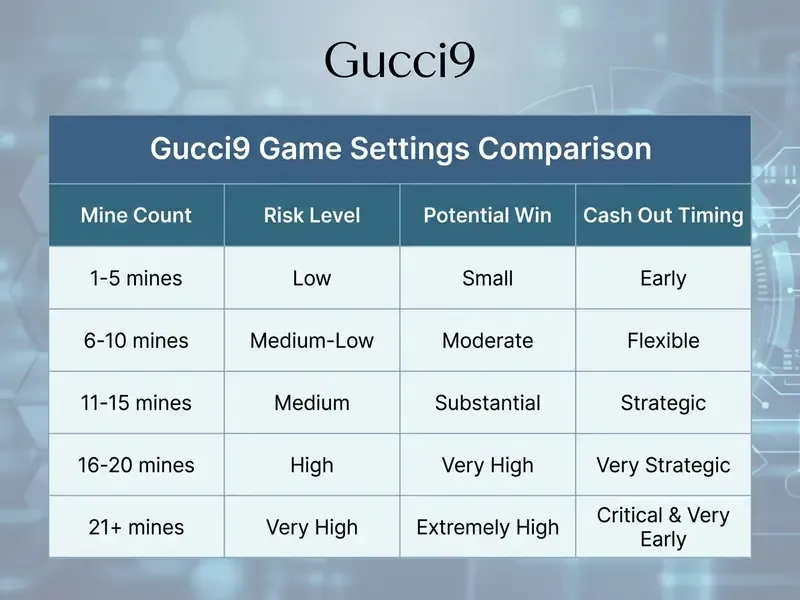
  • The player sets the volatility. Mine count is a user-controlled risk parameter, which is rare in casino content and gives the product an appearance of agency.
  • The player decides when the round ends. Cash-out timing is a genuine decision, even though it does not change expected value.
  • Rounds are extremely short. Because there are no reel animations or forced spin cycles, the game can generate a very high number of betting decisions per hour, which magnifies the impact of the house edge on cumulative loss.

That last point is the one most reviews skip, so it deserves quantification rather than assertion. Event frequency is a well-established structural risk characteristic in gambling-product research: the faster the loop, the more house-edge exposure per session, and the less time between a loss and the next stake. A detailed technical breakdown of Mines put figures on it:

"At 97% RTP with autoplay at 300 rounds per hour, expected loss is roughly US$9 per hour at a US$1 stake."

The arithmetic is trivial and worth internalising: expected hourly loss = stake × rounds per hour × (1 − RTP). Mines has no jackpot mechanic to obscure that relationship, which makes it one of the easiest casino products to model, and one of the fastest to drain a small bankroll.

Try the mechanics before the money. Demo versions of Mines and other instant grid games are available at Casino, gucci9-official.com, with no registration and no stake. Use them to learn the interface, test cash-out discipline and see how volatility changes with mine count, where real-money play is legally permitted in your jurisdiction.

1.2 Mines as simulated gambling and social casino content

The second framing matters because Mines-style grid games appear widely in free-to-play apps, social casinos, sweepstakes casinos and demo lobbies where no money can be won. Australian research distinguishes these forms carefully:

"Hing and colleagues separate loot boxes from simulated gambling games, including social casinos, demonstration modes and gambling-like mini-components inside video games." Hing et al., Convergence of simulated gambling and monetary gambling (2025)

The key structural difference from real-money play is not the interface. It is the payout model:

"Simulated game outcomes are driven by algorithms that inflate winning chances, with bonuses of hundreds of thousands of virtual coins." Hing et al., Convergence of simulated gambling and monetary gambling (2025)

In practice, that means free Mines can deliver long safe streaks and frequent "jackpots" that bear little resemblance to the payout patterns of regulated monetary gambling. A player who learns cash-out timing in a generous simulated build can carry a calibrated-but-wrong sense of hit frequency into a real-money lobby. This is the single most important thing to understand before opening a demo.

2. Which studio made your Mines? Provider comparison

Most confusion about Mines, especially about RTP, dissolves once you identify the studio. The table below consolidates published specifications across the five implementations you are most likely to encounter.

ProviderPublished RTPGrid size(s)Mine rangeMax winBet range (as published)Distinguishing features
Stake Originals~99%5×51-24up to US$1,000,000operator-setProvably fair seeds, live bet feed, in-game chat, hotkeys
BGaming99.00%5×5player-setmultiplier-cappedoperator-setCrypto-first distribution, provably fair option
Spribe97.00% (standard)5×5player-setoperator-cappedoperator-setReleased 2020; provably fair; autoplay; pattern presets
Nyx Gaming96% (varies by jurisdiction)5×51-2410,000× stakeUS$0.20 - US$1,000High table maximum; regulated US/CA lobbies
Hacksaw Gaming92.00%-94.00%3×3, 5×5, 7×7, 9×91-8010,000× stake£0.20 - £25.00Four selectable boards; extreme mine counts; medium volatility label; released 2022
How to read this table. Three

How to read this table. Three of the five headline numbers are ranges or jurisdiction-dependent, not fixed constants. Hacksaw's Mines is commonly listed at 94% by one operator and 92.00% by another, and both are correct for their respective builds. Nyx explicitly notes that "the Return to Player (RTP) rate for this game may differ from one jurisdiction to another". Stake's ~99% figure is frequently quoted online as the RTP of Mines; it applies only to the Stake Originals implementation.

Practical consequence: at A$1 per round and 200 rounds an hour, the difference between a 99% build and a 92% build is roughly A$2 versus A$16 per hour in expected loss, an eightfold difference for a visually near-identical game. Always open the in-game help/paytable panel and read the RTP stated for the build you are actually playing.

3. Mines game mechanics

3.1 The grid, mines and safe

3.1 The grid, mines and safe cells

On the standard 5×5 configuration there are 25 cells. Before the round, the player selects N mines; the remaining 25 − N cells are safe. Positions are determined at round start by the RNG (or by the seed pair in a provably fair build) and do not move mid-round. Every unopened cell is equally likely to hide a mine, which means:

  • there is no deducible information in Mines, unlike Minesweeper: no adjacency numbers, no logic to exploit;
  • each reveal is a draw without replacement from a known population, so probabilities shift with each safe pick;
  • rounds are independent: mine positions are re-randomised each round.

The probability of surviving s consecutive safe picks with N mines on 25 cells is:

P(s) = C(25−N, s) ÷ C(25, s)

And the corresponding zero-edge (fair) multiplier is the reciprocal:

Fair multiplier = C(25, s) ÷ C(25 − N, s)

The operator's displayed multiplier is then:

Displayed multiplier ≈ RTP × C(25, s) ÷ C(25 − N, s)

An RTP audit calculator for Mines lets players and auditors check whether a published paytable matches a 100%, 99% or 97% return model.

This is why Mines is unusually transparent for a casino product: unlike a slot, where the reel weightings are hidden, you can verify the fairness of the entire paytable from first principles. If a displayed multiplier is materially below RTP × fair multiplier, the effective return on that configuration is lower than the headline RTP implies.

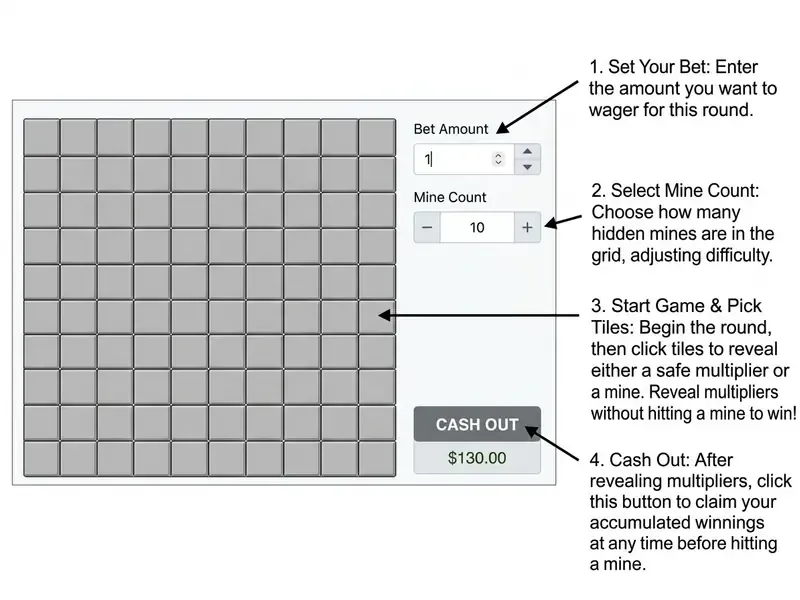
3.2 How to play Mines online

3.2 How to play Mines online: the interface, step by step

A typical real-money Mines round runs as follows.

  1. Open the game from the casino's Instant Win / Originals / Hacksaw category, or via search.
  2. Set the bet using the ± controls or preset chips. Check the minimum and maximum for your build (for example, £0.20/£25 on Hacksaw's release; US$0.20/US$1,000 on Nyx's).
  3. Set the grid size if the build allows it (Hacksaw: 3×3 to 9×9). Larger grids increase the number of possible steps and the ceiling on the multiplier chain.
  4. Choose the number of mines. This is your volatility dial. More mines means a higher multiplier per pick and a lower probability of each pick succeeding.
  5. Press Bet / Play. The stake is debited at this point; individual cell reveals are free.
  6. Reveal cells one at a time. A gem advances the multiplier; a mine ends the round with a total loss of the stake.
  7. Cash Out at any point after at least one safe reveal to bank the current multiplier × stake.
  8. Optional: autoplay. Some builds allow a fixed number of picks, a preset tile pattern and a round count, with stop-on-win/stop-on-loss limits. Autoplay dramatically increases rounds per hour, and therefore expected hourly loss.

3.3 Interface schematic (text version)

+----------------------------------------------+
|  MINES            RTP: xx.xx%   [i] [gear]   |
+----------------------------------------------+
|  Current multiplier: 1.48x   Next: 1.75x     |
|  +----+----+----+----+----+                  |
|  | gem| ?? | ?? | gem| ?? |  <- 5x5 board    |
|  +----+----+----+----+----+                  |
|  | ?? | ?? | gem| ?? | ?? |                  |
|  +----+----+----+----+----+                  |
|  | ?? | ?? | ?? | ?? | ?? |                  |
|  +----+----+----+----+----+                  |
|  | ?? | ?? | ?? | ?? | ?? |                  |
|  +----+----+----+----+----+                  |
|  | ?? | ?? | ?? | ?? | ?? |                  |
|  +----+----+----+----+----+                  |
+----------------------------------------------+
| Mines: [3 v]   Grid: [5x5 v]  Auto: [off]    |
| Bet: [-] A$1.00 [+]     1/2   2x   MAX       |
| +---------------+   +----------------------+  |
| |     BET       |   | CASH OUT  A$1.48     |  |
| +---------------+   +----------------------+  |
+----------------------------------------------+

Before staking, confirm four things are visible and responsive on your screen: the RTP/help panel, the mine-count selector, the full grid without clipping, and the Cash Out button.

3.4 When to lock in a

3.4 When to lock in a result in Mines

Cash-out timing is the only in-round decision that changes anything measurable, and what it changes is the shape of your results, not the edge. Three inputs decide it: the number of mines you selected, the number of cells already opened, and the multiplier you agreed to accept before the round began. Write that number down. In practice, players who decide the exit point in advance stop at 1.48× and 2.00×; players who decide mid-round tend to keep clicking because the next step "is only one more gem away". The board does not know that. Each unopened cell still carries the same odds it had at the start of the round.

4. Payout and probability matrix for a 5×5 grid

No competitor publishes this, and it is the most useful thing on this page. Multipliers below are modelled at 99% RTP on 25 cells; multiply by 0.9798 to convert to a 97% build, or by 0.9293 for a 92% build. Probabilities are exact and independent of RTP.

4.1 Multiplier by mines and successful picks (99% RTP model)

Successful picks1 mine3 mines5 mines10 mines15 mines24 mines
11.03×1.13×1.24×1.65×2.48×24.75×
21.08×1.29×1.56×2.83×6.60×n/a
31.13×1.48×2.00×5.00×18.98×n/a
41.18×1.71×2.60×9.09×63.25×n/a
51.24×2.00×3.39×17.52×253.0×n/a
101.65×4.53×15.13×1,320×n/an/a

4.2 Probability of reaching that step

Successful picks1 mine3 mines5 mines10 mines15 mines24 mines
196.0%88.0%80.0%60.0%40.0%4.0%
292.0%77.0%63.3%35.0%15.0%n/a
388.0%67.0%49.6%19.8%5.2%n/a
484.0%57.8%38.3%10.9%1.6%n/a
580.0%49.6%29.2%5.7%0.4%n/a
1060.0%22.1%6.5%0.08%n/an/a

Worked reading of the table. Playing 3 mines on a 5×5 grid, the first reveal succeeds 88.0% of the time and pays about 1.13×. By the fifth successful pick the multiplier has climbed to roughly 2.00×, but the chance of stringing five safe picks together has fallen to 49.6%, a coin flip. Every cell of both tables is the same trade: the multiplier rises at almost exactly the rate the probability falls, minus the house edge. Model the risk before the round starts, not after the third gem.

4.3 Cash-out reference: where the multiplier crosses key thresholds

Mine countReaches ~1.5× atReaches ~2× atReaches ~5× atChance of losing on pick 1
1 mine10 picks15 picks21 picks4.0%
3 mines~4 picks5 picks11 picks12.0%
5 mines2 picks3 picks7 picks20.0%
10 mines1 pick2 picks3 picks40.0%
15 mines1 pick1 pick2 picks60.0%

Session heuristics that follow from the maths, not from superstition:

Gucci9 heading-banner
  • 1-2 mines:cash out around picks 3-5 if you want visible multiplier movement without an extended chain.
  • 3-5 mines:cash out at picks 2-3; at 5 mines you are already at 2.00× on pick 3.
  • 10+ mines:cash out at picks 1-2, because the chance of losing on the first pick already exceeds 40%.
  • 20+ mines:treat as a lottery ticket, not a strategy; sizing must reflect a greater than 80% chance of immediate loss.

5. RTP, max win and risk in Mines casino offerings

5.1 Published RTP ranges and house edges

ConfigurationRTPHouse edgeExpected loss per A$100 wagered
"Zero-edge" / promotional build100.00%0.00%A$0
Stake Originals / BGaming99.00%1.00%A$1.00
Spribe standard97.00%3.00%A$3.00
Nyx96.00%4.00%A$4.00
Hacksaw (upper)94.00%6.00%A$6.00
Hacksaw (lower)92.00%8.00%A$8.00
Cross-casino average (12 crypto sites)89.83%10.17%A$10.17
BGaming implements Mines at 99.00

BGaming implements Mines at 99.00%, which sits above the industry average of roughly 96% commonly cited for online casino games. Some crypto operators additionally market "fair" or zero-edge Mines with no house edge. Caveat: such offers are best read as promotional configurations rather than standing products. Practical availability, eligible mine counts, wagering requirements and maximum-win caps attached to those builds are frequently restricted, and a 100% theoretical return still produces losing sessions, because variance rather than edge dominates short-run outcomes.

The wide aggregate spread also deserves a plain-language reading. An average of 89.83% across twelve crypto casinos, with a reported floor of 0%, indicates that some listings are either mis-configured, mis-reported, or reflect data-collection artefacts rather than playable settings. The safe inference is not "Mines pays 89.83%" but rather: do not assume a headline RTP applies to the lobby you are in; verify it in-game.

Compare before you deposit. Version differences matter more than bonus size: review the RTP, mine limits, maximum-win cap and bonus contribution of each Mines build listed at Casino, gucci9-official.com before your first deposit, and only where such play is lawful for you.

5.2 Why RTP and max win

5.2 Why RTP and max win must be checked in the game rules

Four mechanisms explain nearly every discrepancy you will find online.

  1. Multiple certified builds. Providers ship the same title at several return settings; operators choose one. This is why 92% and 94% coexist for Hacksaw's Mines.
  2. Jurisdictional requirements. Regulators impose minimum RTPs, maximum stakes, mandatory reality checks and spin-speed limits, so the same title differs by market, as Nyx's own disclaimer states.
  3. Bonus-money rules. A build played with bonus funds may carry a maximum-bet rule, a maximum cash-out and a wagering contribution rate that changes effective return dramatically.
  4. Paytable rounding. Displayed multipliers are rounded, usually downwards, which shaves a small amount off theoretical return at some steps.

Rule of thumb: the game's own i / help panel is the only authoritative source for the build in front of you. Marketing pages, affiliate reviews and even provider fact sheets can all be describing a different configuration.

5.3 Maximum win limits and volatility

5.3 Maximum win limits and volatility

Published maximum wins cluster around 10,000× stake (Hacksaw, Nyx) or an absolute currency cap such as US$1,000,000 (Stake Originals). Both matter more than they appear:

  • A 10,000× cap makes some deep high-mine chains mathematically unpayable, because the theoretical multiplier exceeds the cap, so the true return on those configurations is lower than the paytable implies.
  • An absolute currency cap interacts with stake size: at high stakes, the cap can bind at a lower multiplier than at low stakes.

Volatility is player-set, which is unusual and behaviourally significant. High-mine configurations produce long strings of small losses punctuated by rare large wins.

Gambling research indicates that high-volatility products encourage risk-taking and cognitive distortions, notably loss-chasing. Hing et al. (2025), consistent with Australian Institute of Family Studies and NSW survey findings

The practical implication is that a big early win in a high-mine session is the most dangerous outcome, not the best one: it recalibrates expectations upwards precisely when the underlying probabilities have not changed at all.

  1. Provably fair: how to verify a Mines round

Provably fair systems let a player confirm after the fact that mine positions were fixed before their first click. Spribe identifies Mines as provably fair, and Stake Originals and BGaming builds publish seed pairs. The verification loop is:
1
Before the round, copy the hashed server seed (a SHA-256 digest) and note your client seed. Most builds let you set the client seed yourself, which is the point.
2
Play the round. Mine positions are derived deterministically from server seed plus client seed plus nonce.
3
After the round, request or rotate to reveal the unhashed server seed.
4
Hash the revealed server seed with any SHA-256 tool. The output must match the hash you copied in step 1. If it matches, the server could not have altered mine positions after seeing your picks.
5
Recompute the shuffle using the provider's published algorithm (typically HMAC-SHA-256 over the seed pair and nonce) to confirm mine placement matched the round you saw.

"To confirm a round was fair, copy the client seed and hashed server seed before play, then re-hash the revealed server seed in any SHA-256 tool and compare."

Important limits of provably fair. It

Important limits of provably fair. It proves the outcome was not tampered with. It does not prove the RTP is what the operator claims, does not certify the paytable, and does not verify that withdrawals will be honoured. Those require independent testing (eCOGRA, iTech Labs, GLI) and a licence.

Evidence gap, stated plainly: in preparing this guide we were not able to locate publicly accessible, provider-issued RTP specifications or independent audit certificates for Mines-type titles from eCOGRA or iTech Labs. Absence of a public certificate is not proof of absence of testing, but it does mean players should treat any single quoted RTP as unverified unless it appears in the game's own help panel or a licensee's published game rules.

7. Mines demo and Mines free: how to try the game without risk

7.1 Demo and free-play modes in

7.1 Demo and free-play modes in Mines

A Mines demo runs on a virtual balance. Stakes and wins are notional, nothing can be deposited or withdrawn, and the balance typically resets on refresh. Functionally, Mines free play lets you:

  • learn the interface and the location of the Cash Out control;
  • watch how the multiplier ladder changes as you move mine count from 1 to 24;
  • rehearse cash-out discipline against a written plan;
  • confirm the build renders correctly on your device.

What demo play cannot do is train you to win, because there is nothing to learn: outcomes are independent and the edge is fixed. And there is a documented reason to be cautious:

"Practice games mimic gambling but often misrepresent it, using inflated payout rates to draw players toward real-money wagering." Hing et al., Convergence of simulated gambling and monetary gambling (2025)

That is the point most demo-mode guides omit: the primary purpose of practice games is to promote the real-money version of the game.

7.2 Empirical evidence on simulated gambling and convergence with monetary gambling

The research base here is now substantial enough to state confidently.

"All cross-sectional studies identified an association between simulated gambling and greater problem-gambling severity among adolescents and adults." Hing et al., Convergence of simulated gambling and monetary gambling (2025)

Specific findings worth knowing:

Gucci9 heading-banner
  • Germany:participation in all forms of simulated gambling except lotteries predicted the frequency of real-money gambling after controlling for age, gender, income and education.
  • Migration rate:"Around 20% of adults and adolescents who play simulated gambling games move to online commercial gambling." Australian Institute of Family Studies research snapshot on simulated gambling games.
  • Canada:"26% of participants had migrated to online gambling from social casino games; the only significant predictor was spending money on virtual credits." Canadian study cited in the Victorian responsible gambling review.

Taken together: it is not exposure alone but paying for virtual credits that most strongly flags migration risk. If a free Mines build has ever prompted you to buy coins and you did, treat that as a signal worth acting on.

7.3 Youth migration, practice modes and protective factors

Protective factors have been identified across three separate studies:

  • Dussault et al. (2017) identified low impulsivity as protective against migration.
  • Kim et al. (2015) identified not making micro-transactions in social casino games as protective.
  • Hayer et al. (2018) identified lack of access to simulated gambling at home as protective.

Risk factors run in the opposite direction:

A German study found that playing social-network gambling games at home and exposure to gambling advertising predicted migration from simulated to monetary gambling.

For parents and carers, this converts into three concrete levers: restrict home access to gambling-simulating apps, block or limit in-app purchases at the operating-system level, and reduce exposure to gambling advertising in streaming and social feeds.

7.4 Social casino markets and regulatory responses in Australia

Australia is a disproportionately large market for this content relative to population.

According to ACMA's market snapshot, Australians spent approximately US$115.8 million on social casino games in the first half of 2022, the fourth-largest market globally.

Consumer spending on mobile slots games in Australia in 2021 was US$302 million. Regulators have responded through the classification system rather than gambling law:

The Australian Government's updated Guidelines for the Classification of Computer Games (2023) set a minimum R18+ rating for games containing simulated gambling and M for paid loot boxes.

Because Mines-style grid games can appear inside broader app bundles, classification enforcement is imperfect in practice, which is why household-level controls remain the most reliable protection for minors.

8. Mines real money: legality, offers, payments and risk

8.1 Legal status of online casinos

Under the Interactive Gambling Act 2001 (Cth), it is prohibited to supply "interactive gambling services", which includes online casino games such as Mines, to customers physically located in Australia. In practice this means domestic operators cannot offer real-money Mines casino games to Australian residents, and offshore sites that do so are operating unlawfully with respect to the Australian market. ACMA maintains a complaints process and requests ISP-level blocking of offending sites.

The consequences for a player are practical, not theoretical:

  • No local consumer protection. Disputes cannot be escalated to an Australian regulator.
  • Payment friction. Australian banks and card schemes routinely decline gambling-coded transactions to offshore casinos.
  • Withdrawal risk. Funds held with an unlicensed offshore operator may be frozen, forfeited under opaque terms, or lost if the site closes.
  • Self-exclusion gaps. BetStop, the National Self-Exclusion Register, covers licensed Australian services, not offshore casinos.

Legal online gambling for Australian residents is limited to licensed wagering (sports and race betting), lotteries and keno through licensed operators. If you are researching online casino products from a jurisdiction where such play is permitted, licensing and terms should still be verified first.

8.2 Accessing Mines offers and reading the terms

Where real-money play is lawful for you, the sequence is: choose a licensed operator, register and complete identity verification, deposit, then navigate to the Mines game in the casino's menu, usually under Instant Win, Originals or the provider's own category, or via search. Before you place a first stake at any online casino or crypto platform, read four numbers in the terms.

Term to checkWhy it matters for Mines specificallyTypical range
Wagering contributionInstant/originals games often contribute little or nothing to bonus turnover, so a bonus may be effectively unusable on Mines0%-10%
Maximum bet with bonus fundsBreaching it can void the bonus and any winnings, even accidentally on autoplayA$5-A$8 per round
Maximum cash-out from bonusCaps what you can withdraw regardless of a big multiplier hit3×-10× bonus
Game-specific exclusionsSome operators exclude high-RTP originals from bonus play entirelyvaries

Reader-facing rule: if Mines contributes 0% to wagering, treat any bonus as irrelevant to Mines play and evaluate the offer on cash terms only.

8.3 Payments, verification and withdrawals. Because

8.3 Payments, verification and withdrawals

Because this is the most common source of complaints, keep expectations calibrated.

  • Deposit methods commonly advertised to Australian audiences include PayID, POLi-style bank transfers, Neosurf vouchers, prepaid cards and cryptocurrency. Availability changes frequently and bank declines are common for gambling-coded merchants.
  • KYC/AML verification is mandatory at licensed operators and usually triggered at first withdrawal: photo ID, proof of address dated within three months, and proof of payment ownership. Complete it before you deposit to avoid withdrawal delays.
  • Withdrawal timing is a two-stage process: internal review (often 24-72 hours; sometimes instant for crypto) plus rail time (crypto: minutes to hours; bank transfer: 1-5 business days).
  • Common causes of delay: mismatched name on payment method, incomplete source-of-funds documentation, unmet wagering requirements, and withdrawal requests made while a bonus is active.
8.4 Red flags worth walking away

8.4 Red flags worth walking away from

A short checklist, because most complaints about instant games start with the operator rather than the maths:

  • no licence number, licensee name or registered address on the legal page;
  • terms that reserve a right to change wagering conditions "at any time" without notice;
  • an RTP shown in marketing that does not match the in-game help panel;
  • support that cannot answer a direct question about maximum cash-out from a bonus;
  • verification requests that expand after a withdrawal is submitted, rather than before;
  • no deposit limit, loss limit, session timer or self-exclusion option in the account settings.

One of those on its own may be sloppiness. Three of them together is a pattern.

8.5 Financial risk, gambling harm and disclaimers

Mines is a negative expected-value product. Over any meaningful number of rounds the mathematically expected outcome is a loss equal to the house edge multiplied by total turnover, and turnover, not stake size, is the figure that matters, because a 300-round hour at A$1 is A$300 of turnover.

Disclaimer. This information is general in nature and is not financial, legal or clinical advice. RTP is a long-run theoretical figure and does not guarantee any result in an individual session or round. Online casino games may be unlawful in your jurisdiction, including in Australia under the Interactive Gambling Act 2001. Check age requirements and offer conditions before playing. Never stake money you cannot afford to lose. 18+ only.

Australian harm data provides scale. The

Australian harm data provides scale. The NSW Gambling Survey 2024 found that one in five respondents (21.0%) experienced gambling harm, comprising 7.8% harmed by their own gambling, 12.7% harmed by another person's gambling, and 7.1% harmed by gambling that occurred more than 12 months earlier. Overall gambling participation was 53.5%, and online casino games were among the sources of harm identified.

Two observations follow. First, harm from someone else's gambling is more prevalent than harm from one's own, a reminder that household impact is not a secondary consideration. Second, harm persists beyond the gambling itself, which is why financial and relationship consequences are part of the risk profile, not just losses.

9. Mines strategy: how to choose an approach

9.1 The starting premise

No sequence of cell selections, no cash-out rule, no stake progression and no "pattern" changes the RTP of a Mines build. What a Mines strategy can change is the shape of the outcome distribution: how often you win, how much you win when you do, and how quickly your bankroll can be destroyed. That is a real choice, and it is worth making deliberately.

9.2 Low risk play and an

9.2 Low risk play and an early cash out: the 1:1 ratio

Method. Set 1 mine. Reveal one cell. Cash out immediately. Repeat.

Maths. Win probability 96.0% (24/25). Multiplier ≈ 1.03× at 99% RTP, ≈ 1.01× at 97%.

The trap. Profit per win at 99% RTP is about +0.0297 units; a loss costs 1.00 unit. One mine hit therefore erases roughly 34 consecutive wins. At 97% RTP, profit per win falls to about 0.0104 units and a single loss erases about 96 wins. On a 92% build, the configuration is unplayable on this plan, because the multiplier barely exceeds 1.00×.

Verdict. Psychologically comfortable, statistically brutal. Only coherent on high-RTP builds, with a hard stop-loss and a session round limit.

9.3 Progression systems Martingale and Fibonacci

9.3 Progression systems: Martingale and Fibonacci

Competitor guides recommend Martingale, "double your entry after each loss and return to your original stake after each win", without stating its precondition.

The precondition almost everyone omits: doubling only recovers a prior loss if you cash out at 2.00× or more. At 1 mine and 1 pick (1.03×), doubling recovers about 3% of the previous loss. It does not work. To make Martingale arithmetically coherent on Mines you must select a step where the multiplier is at least 2×, for example 5 mines / 3 picks (2.00×, 49.6%) or 10 mines / 2 picks (2.83×, 35.0%).

Risk of ruin at a coherent Martingale setting. Take 5 mines, cash out at 3 picks: loss probability per round is about 50.4%.

Consecutive lossesProbabilityCumulative stake required (base = 1 unit)
312.8%7 units
53.3%31 units
70.84%127 units
90.21%511 units
110.055%2,047 units
Over 500 rounds you should expect

Over 500 rounds you should expect at least one seven-loss streak. A 100-unit bankroll survives six doublings; the seventh requires 64 units on a single round. This is the mechanism by which Martingale converts a small, steady house edge into an occasional total loss. The edge is unchanged; only the loss distribution is reshaped.

Fibonacci variant (3 mines, cash out on the third gem, ≈1.48× at 99% RTP or ≈1.42× at 95%). Stakes progress 1-1-2-3-5-8-13 on losses, stepping back two on a win. It escalates more slowly than Martingale, but a 1.48× payout does not fully recover a Fibonacci-scaled deficit, so recovery is partial and drawdowns lengthen. Win probability per round is 67.0%; the chance of five consecutive losses is 0.4% per attempt, small but not rare across a long session.

Neither progression changes expected value. Both convert "small frequent losses" into "small frequent wins plus rare catastrophic losses". If you use one, set the maximum number of doublings before you start, and treat that limit as absolute.

9.4 More mines why high risk

9.4 More mines: why high risk does not guarantee a win

Method. Raise mine count to 10-24 and cash out after 1-2 picks, chasing multipliers from 1.65× to 24.75×.

Maths. At 10 mines, the first pick fails 40% of the time; at 15 mines, 60%; at 24 mines, 96%. The multiplier growth is steep, 253× at 15 mines and five picks, but the probability of getting there is 0.4%.

Some players nonetheless develop personal rituals, fixed tile orders, "hot corner" theories, or pseudo-systems based on previous rounds, despite each round being independent and each unopened cell being equally likely. This is the classic gambler's fallacy applied to a memoryless product, and its consequences are documented:

The Australian Institute of Family Studies notes that people who move into gambling for the "challenge" or because they believe game skills transfer are at risk of harm when they overestimate their control over outcomes.

Mines is unusually good at generating this illusion, because the decisions (mine count, tile order, cash-out point) are real even though only one of them, the cash-out point, affects the distribution at all, and none affects the edge.

9.5 Pattern play: corners, diagonals and presets

Method. Open a fixed pattern, say the four corners, at a low mine count.

Maths (2 mines, four corners). Probability = (23/25) × (22/24) × (21/23) × (20/22) = 70.0%, paying about 1.41× at 99% RTP. A widely circulated figure of 68.3% for this configuration is incorrect; the exact value is 70.0%.

Verdict. Patterns are useful only as discipline devices, because they pre-commit you to a stopping point, which prevents in-round escalation. They confer no statistical advantage whatsoever, because cell position is irrelevant.

9.6 Strategy comparison at a glance

StrategySettingWin ratePayoutMain riskSuitable for
1:1 ratio1 mine, 1 pick96.0%~1.03×One loss erases ~34 winsHigh-RTP builds only, with a strict round cap
Balanced3 mines, 3 picks67.0%~1.48×Steady grind, moderate drawdownLongest session time per unit staked
Threshold cash-out5 mines, 3 picks49.6%~2.00×Coin-flip varianceThe only sensible base for any doubling plan
More mines10+ mines, 1-2 picks35-60%1.65×-2.83×High variance, fast bankroll depletionShort, pre-funded, entertainment-only sessions
Lottery play24 mines, 1 pick4.0%~24.75×96% immediate lossNovelty only
Martingaleany step at 2× or aboven/an/aRare total lossNot recommended
9.7 Evidence gaps and harm-minimisation measures

9.7 Evidence gaps and harm-minimisation measures

Stated carefully: we did not identify peer-reviewed Australian experiments or case studies published between 2023 and 2025 that test whether particular Mines strategies improve outcomes or reduce harm among players. Read that as an evidence gap in the published literature rather than as proof that no such research exists. What is well evidenced is that structural characteristics, namely event frequency, player-set volatility and continuous availability on mobile, are associated with elevated harm risk.

The measures with the best evidentiary support are not strategies at all. They are limits.

  • Set a deposit limit before your first session and never raise it in-session.
  • Set a loss limit in dollars, not rounds, and honour it on the first breach.
  • Set a time limit and use reality-check reminders where available.
  • Cap turnover, not just stake. Autoplay is the fastest route to a large hourly loss.
  • Never chase. A loss-recovery impulse is the strongest single predictor of a bad session.
  • Never gamble with borrowed money or funds allocated to essentials.
  • Use self-exclusion tools. In Australia, BetStop covers licensed services; operator-level self-exclusion and blocking software cover more ground.
  • Keep a written session log of deposits, withdrawals and time played. Most people underestimate turnover by a wide margin.

10. Mines mobile and Mines download

10.1 There is no official standalone Mines app

This needs saying bluntly, because it is the most common misconception on the topic, driven by affiliate pages promoting "Mines APK" downloads. Neither Spribe nor Hacksaw Gaming publishes a consumer-facing standalone Mines application. Mines is delivered in one of four ways.

Delivery methodWhat it actually isNotes
Mobile browser (HTML5)The casino's responsive web clientMost common; no install; works in Safari and Chrome
PWA (progressive web app)"Add to Home Screen" shortcut wrapping the web clientLooks like an app; is not from an app store
Licensed operator appThe casino's own iOS/Android app, containing Mines in its lobbyDistribution depends on store policy and jurisdiction
Third-party "Mines APK"An unofficial wrapper or cloneHigh risk: malware, credential theft, no licence, no payouts

Claims that you can "download the Mines game to win money as a standalone app" should be treated as marketing rather than fact. If real-money play is lawful for you, obtain the app from the operator's official site or an official app store, never from a file-sharing link.

10.2 Touch interface considerations. Mines adapts

10.2 Touch interface considerations

Mines adapts well to touch because it has no reels and few controls, but there are recurring mobile issues worth checking:

  • Accidental taps. Cells are large but adjacent; a mis-tap ends a round instantly and irreversibly. Some builds add a confirmation toggle, so enable it.
  • Cash Out placement. On small screens the Cash Out button can sit near the thumb rest, causing premature cash-outs, or be pushed below the fold on larger grids.
  • Grid clipping. 7×7 and 9×9 boards can clip in portrait mode on narrower devices; landscape usually restores the full board plus paytable.
  • Connection loss mid-round. Reputable builds preserve round state server-side and restore it on reconnect. Verify this behaviour in demo mode before staking.

10.3 Seven-point mobile pre-flight checklist

1. Connection stability , with no
  1. Connection stability, with no repeated reconnects or page-refresh loops during load.
  2. Full grid rendering, with every cell visible and tappable, no clipping or overlap.
  3. Cash Out visible, present and enabled before your first pick, not only after a win.
  4. RTP and rules panel accessible, so you can confirm the build's actual RTP in the i or help screen.
  5. Licence and operator identity, with licence number and licensee name shown on the site's legal page.
  6. Responsible-gambling tools reachable: deposit limits, session limits, self-exclusion, and a local help line.
  7. State responsiveness, so the board and multiplier update immediately after each tap, with no frozen tiles or lagging cash-out value.
10.4 Mobile play, youth exposure and

10.4 Mobile play, youth exposure and regulatory considerations

Mobile delivery is where the real-money and simulated-gambling worlds converge most tightly: the same grid, the same animations and the same cash-out button appear in both a licensed casino client and a free app installed on a teenager's phone. As noted above, Australia's updated classification guidelines (2023) set a minimum R18+ rating for games containing simulated gambling and M for paid loot boxes, aiming to restrict access for minors. Enforcement across app stores and web-based content remains partial, and exposure to gambling advertising can shape migration pathways. A German study found that playing gambling-style games at home and advertising exposure both predicted movement from simulated to monetary gambling.

For households, the practical controls are device-level: operating-system age restrictions, disabling in-app purchases, DNS or router-level blocking of gambling domains, and, for adults at risk, dedicated blocking software alongside BetStop registration.

11. Synthesis of 2023-2025 Australian evidence

11.1 Key findings from Hing et al. (2025)

"Hing and colleagues review cross-sectional and longitudinal studies from Canada, Germany and Norway, using PGSI and NODS-CLiP to assess problem-gambling severity." Convergence of simulated gambling and monetary gambling (2025)

Their principal conclusions relevant to Mines-style content:

  • simulated gambling, including social casinos, demo modes and gambling-like mini-games, is consistently associated with monetary gambling participation;
  • simulated products systematically misrepresent gambling odds via inflated payout algorithms and outsized virtual bonuses;
  • cross-sectional studies uniformly link simulated gambling with greater problem-gambling severity in both adolescents and adults;
  • longitudinal work supports a directional pathway from simulated to monetary gambling in a substantial minority of players.
11.2 Insights from the NSW Gambling

11.2 Insights from the NSW Gambling Survey 2024 and ACT Young Adults Gambling Online 2024

The NSW Gambling Survey 2024 surveyed a random sample of 10,000 adult residents between March and May 2024. Total gambling participation was 53.5%, broadly stable against 53% in 2019, while 21.0% reported gambling harm (7.8% own gambling; 12.7% another person's; 7.1% gambling more than 12 months prior). Participation in online casino games had increased relative to earlier waves, despite such services being unlawful to supply into Australia.

The ACT Young Adults Gambling Online (2024) report focuses specifically on young adults in the Australian Capital Territory. With an explicit limitation: we were unable to verify its sample size, sampling method or headline prevalence estimates from a primary copy of the report, so no figures are attributed to it here. Readers seeking jurisdiction-specific youth data should consult the report directly through the ACT Gambling and Racing Commission rather than relying on secondary summaries, including this one.

11.3 What the evidence does not

11.3 What the evidence does not tell us

Intellectual honesty requires listing the gaps, because they are large:

  • No Mines-specific prevalence data. No Australian survey isolates Mines or "instant grid" games as a category.
  • No published independent audit certificates for Mines RTP that we could locate publicly.
  • No experimental evidence that any cash-out rule or stake progression reduces harm.
  • No longitudinal Australian cohort tracking movement from demo Mines specifically into real-money play.
  • Causality remains partly open. Most convergence evidence is cross-sectional; shared underlying traits such as impulsivity plausibly contribute to both behaviours.

  1. FAQ

13. Conclusion. Mines is the most

  1. Conclusion

Mines is the most mathematically legible product in the modern casino lobby. Its entire payout structure reduces to a single combinatorial expression, its probabilities can be tabulated exactly, and in provably fair builds its outcomes can be independently verified. That transparency is genuinely unusual, and it cuts both ways, because the same arithmetic that lets you audit the paytable also shows, with no ambiguity, that the multiplier ladder rises at almost precisely the rate the survival probability falls, less the house edge.

Three conclusions follow. First, identify your build before anything else: the difference between a 99% and a 92% deployment is an eightfold difference in expected hourly loss for a visually identical game. Second, turnover is the variable to control, not stake size, because a 300-round hour at A$1 is A$300 wagered and autoplay makes that effortless. Third, strategy is a distribution choice, not an edge: mine count and cash-out point determine how your losses arrive, never whether they do.

The research context is equally clear-cut.

"There is compelling and consistent evidence of convergence between simulated gambling, monetary gambling and problem gambling." Hing et al., Convergence of simulated gambling and monetary gambling (2025)

Around 20% of people who play simulated gambling games move to online commercial gambling, and one in five NSW adults surveyed in 2024 reported gambling harm, more often from someone else's gambling than their own. Free Mines is not a neutral training ground; its inflated payout algorithms teach expectations that real-money builds will not honour.

Before moving from demo to stakes, confirm that play is lawful where you are, that the operator is licensed with transparent terms, and that deposit and loss limits are in place. Current RTPs, bet limits and responsible-gambling tools for the games covered here are set out at Casino, gucci9-official.com.

Play Mines, if you play it at all, as a paid entertainment product with a known and quantified price per hour. Set the limits first, log what you spend, and treat any impulse to recover a loss as the signal to stop, not the signal to double.

14. Appendix A: corrections to widely repeated claims

Retained here for transparency, because these statements circulate widely and readers deserve to see them addressed rather than quietly omitted.

Circulating claimStatusCorrection
"The RTP for Mines is 94%."Contradictory, build-specificHacksaw Gaming's Mines is documented at both 92.00% and 94.00% depending on the deployment. Verify in-game.
"The RTP for Mines is around 99%."Supported, but scope-limitedApplies to Stake Originals (and BGaming at 99.00%). Spribe is 97%, Nyx 96%, Hacksaw 92%-94%.
"Download the Mines game to win money as a standalone app."UnsupportedProviders do not publish a consumer Mines app. Play occurs via a casino's web client, PWA, or licensed operator app.
"One mine hit cancels the profit of 25-30 winning rounds at 1 mine / 1 pick."UnderstatedAt 99% RTP it takes about 34 wins to recover one loss; at 97% RTP, about 96 wins.
"Four-corner play with 2 mines succeeds 68.3% of the time."IncorrectThe exact probability is 70.0%, paying about 1.41× at 99% RTP.
"Use Martingale with a 12×12 minefield on a 5×5 originals build."Inconsistent5×5 originals builds do not offer a 12×12 board; Hacksaw offers 3×3 to 9×9. Also, doubling cannot recover a loss at multipliers below 2.00×.
"Multipliers increase in steps: 1.11×, 1.27×, 1.46×, 1.69×."Build-specificThese correspond to a particular mine count and RTP configuration; the general formula is RTP × C(25,s) ÷ C(25−N,s).
"High risk guarantees bigger wins over time."UnsupportedHigher variance changes the distribution of outcomes only. Expected value remains negative at any RTP below 100%.
15. Appendix B methodology, limitations and

  1. Appendix B: methodology, limitations and help services

How this guide was produced. Provider specifications were compiled from publicly published game pages, operator paytables and provider product materials, then cross-checked against each other; where figures conflict, both are reported with the conflict stated. All probability and multiplier figures in Sections 4 and 9 were calculated from first principles using the hypergeometric survival function P(s) = C(25−N,s) ÷ C(25,s) and its reciprocal, then scaled by the stated RTP, so they are reproducible in any spreadsheet. Behavioural and prevalence claims are drawn from Hing et al., Convergence of simulated gambling and monetary gambling (2025), the NSW Gambling Survey 2024, Australian Institute of Family Studies research snapshots on simulated gambling games, ACMA market data, and the Australian Government's updated Guidelines for the Classification of Computer Games (2023).

Stated limitations. We could not access primary provider RTP certificates or independent audit reports (eCOGRA, iTech Labs) for Mines-type titles, and we could not verify the sample size or findings of the ACT Young Adults Gambling Online (2024) report from a primary copy. Where a URL for a cited document was not available to us, the source is named by title, publisher and year rather than linked, so that readers can retrieve it directly. Multipliers shown are modelled values; operator paytables round and may deviate.

Currency and review. Game specifications, RTP deployments, bonus terms and regulatory positions change frequently. This guide is reviewed on a rolling basis by the iGaming research desk at gucci9-official.com; the version date appears at the top of the page. Verify all figures against the live game and the operator's terms before you play.

Getting help in Australia.

Gucci9 heading-banner
  • Gambling Help Online:1800 858 858, 24/7 phone and online counselling, free and confidential.
  • BetStop:the National Self-Exclusion Register for licensed Australian wagering services.
  • Lifeline:13 11 14, for crisis support.
  • Financial Counselling Australia / National Debt Helpline:1800 007 007, free financial counselling.
  • ACMA:accepts complaints about illegal offshore gambling services offered to Australians.

Final disclaimer. This article is general information and entertainment-focused analysis. It is not financial, legal, medical or gambling advice, and it does not encourage participation in gambling. Gambling can be addictive and can cause financial, relationship and mental-health harm. 18+ only. Only ever stake money you can genuinely afford to lose, and check whether an operator is licensed in your own jurisdiction before depositing.